The Holy Trinity of Orthopedic Implant Design

The Holy Trinity of Orthopedic Implant Design

Strength, Flexibility, and Porosity Achieved Through Load Path Cellular Metal (LPCM)

Author: Kambiz Behzadi, MD
Affiliation: Behzadi Medical Device
Presented at: International Society for Technology in Arthroplasty (ISTA), Rome 2025 and LSI Europe London, 2025

Abstract

Orthopedic implant design is trapped between two unsatisfying extremes. Traditional bulk-metal designs in Ti-6Al-4V and CoCr-Mo offer excellent strength and fatigue life, but are 6–10× stiffer than bone. This stiffness mismatch produces non-physiologic load transfer, stress shielding, and progressive bone resorption, ultimately undermining long-term fixation. At the other extreme, porous and cellular metallic architectures—enabled by additive manufacturing—better match bone modulus and support osseointegration, but suffer from junctional fatigue, manufacturing defects, and micromotion levels that push healing toward fibrous encapsulation rather than bone integration.

For decades, the industry has tried to compensate with increasingly sophisticated geometry: collars, flares, wedges, tapers, and “fit-and-fill” stems. These geometry-based load paths improve primary stability but provide only a handful of crude load-path “hacks” that do not reproduce the distributed, hierarchical load sharing of native bone—especially under high loads such as running (5–7× body weight).

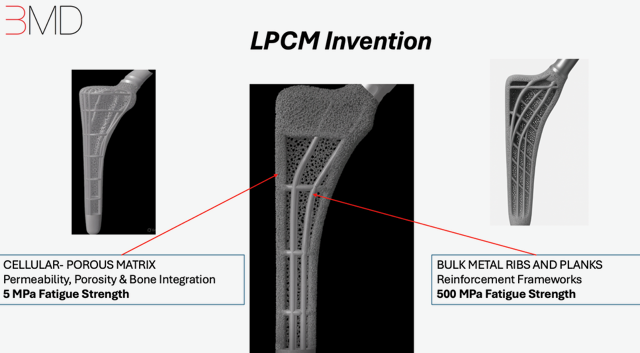
This white paper introduces Load Path Cellular Metal (LPCM): a structural architecture that embeds bulk-metal ribs, planks, and tubes within a functionally graded cellular matrix. LPCM achieves the holy trinity of orthopedic design—strength, flexibility, and porosity—with each parameter independently tunable. Instead of relying on geometry alone, LPCM uses engineered load paths to create biological load sharing, aligning implant mechanics with bone biology and opening a path to implants that can safely support higher functional demands while preserving bone stock.


1. The Strength–Stiffness Paradox

1.1 Bulk metals: strong, but too stiff

The modern era of cementless arthroplasty has been built on α- and α+β-titanium alloys and cobalt–chromium alloys. These materials are mechanically robust:

  • Ti-6Al-4V: elastic modulus ~110 GPa (≈6× cortical bone)
  • CoCr-Mo: elastic modulus ~220 GPa (≈10× cortical bone)
  • Cortical bone: ~20 GPa (order-of-magnitude lower)

They offer high yield strength and fatigue life (>800 MPa in many clinical alloys), but their stiffness is fundamentally misaligned with bone. When a stem that is 6–10× stiffer than the surrounding bone is press-fit or cemented into the femur, it carries a disproportionate share of the load. The proximal femur becomes under-strained, triggering:

  • Stress shielding
  • Proximal bone resorption (notably in Gruen zone 7)
  • Long-term loss of bone stock, which complicates revision and increases fracture risk

Clinically, this manifests as “aseptic loosening” and periprosthetic bone loss. Mechanically, it is a mismatch between where the implant wants to carry load and where bone needs to feel it to remain healthy.

1.2 Intuitive mismatch

Even to a non-scientist, placing an implant that is up to an order of magnitude stiffer than osteoporotic bone into an elderly patient is counter-intuitive. Bone thrives on physiologic stress; shield it from load and it weakens. Yet current “solutions” still deploy very stiff bulk metals, then attempt to patch over the mismatch with geometry tweaks and coatings.

2. The Partial Solution: Cellular and Porous Metals

2.1 Why porous metals looked like the answer

Additive manufacturing introduced a second design space: cellular and porous metallic structures. By adjusting:

  • Unit cell topology
  • Relative density
  • Pore size and connectivity

engineers can reduce effective modulus into the 20–40 GPa range—far closer to cortical bone—and create porosity (100–400 µm) ideal for bone ingrowth and vascular perfusion. Porous Ti constructs have been shown to dramatically reduce stress shielding compared to monolithic CoCr stems.

On paper, this solved the stiffness mismatch and supported osseointegration. But it introduced new—and equally fundamental—mechanical problems.

2.2 The Achilles’ heel: junctions and nodes

Lattice structures suffer from inherent stress concentrations at their junctions and nodes. Regardless of how sophisticated the topology optimization, several issues recur:

  • Junctional fatigue: The highest cyclic stresses occur at strut intersections; fatigue cracks initiate here and propagate through the lattice.
  • Manufacturing defects: Lack-of-fusion pores, surface roughness, unmelted powder, and residual stress magnify local peak stresses at these same nodes.
  • Limited crack arrest: Once a crack initiates in a lattice, there is often no robust “backup” pathway to redistribute load, so global failure follows local weakness.

The result: porous metals are mechanically compliant, but structurally fragile—particularly under the multiaxial, high-cycle loading of daily life.

2.3 Micromotion and fibrous tissue

There is a second, subtler failure mode. Decreasing stiffness reduces load transfer into the implant and increases relative micromotion at the bone–implant interface. When this micromotion exceeds roughly 50 µm, the biologic response shifts from bone ingrowth to fibrous tissue formation.

Thus, ultra-compliant porous zones can paradoxically:

  • Reduce stress shielding locally, but
  • Destabilize the interface mechanically, leading to fibrous encapsulation rather than stable osseointegration.

In summary:

  • Bulk metals are too strong for biology (overly stiff, under-stimulate bone).
  • Porous metals are too biological for mechanics (insufficient fatigue strength, excessive micromotion).

The field has been oscillating between these two unsatisfying corners of the design space.

3. The Geometry Plateau: Load-Path Hacks

3.1 Six geometry families, one underlying problem

While materials oscillated between bulk and porous, designers also pursued geometric optimization. Collars, shoulders, wedges, flares, tapers, splines, and “fit-and-fill” shafts created six widely recognized classes of cementless femoral stems.

These strategies deliver:

  • Primary stability through cortical engagement in specific zones
  • Acceptable performance for walking (1–2× body weight)
  • Registry-level survivorship that appears “good enough” on 10–15-year curves

But geometry is fundamentally a finite menu of load paths.

3.2 Why geometry can’t finish the job

Geometry-based load paths have two core limitations:

  1. Overstressed cortical contact zones
    • By wedging into small cortical regions, stems drive high local stresses through limited contact areas.
    • These sites become the primary—and sometimes only—load paths, far from the distributed strain field that native bone experiences.
  2. Reduced true bone–implant contact area
    • In pursuit of tight “fit,” many designs lift off from broad metaphyseal regions, reducing actual surface contact.
    • This compromises secondary stability and long-term osseointegration, even when initial press-fit feels solid.

Under walking loads, these geometry hacks achieve acceptable fixation. Under running or high-impact loads (5–7× body weight), they reveal their limitations:

  • Load is funneled through a few stiff, monolithic paths.
  • Bone outside those paths is under-strained and remodels away.
  • Interfaces can fail when cyclic stress concentrates at a limited number of geometric “hot spots”.

Geometry can produce primary stability, but it cannot independently control:

  • Local stiffness distribution
  • Fatigue strength at microscopic scales
  • Interface micromotion

This is why, even in 2025, we still routinely tell patients: “Don’t run on your new hip or knee.” The implants are strong enough; their load paths are not biologically aligned.

4. From Geometry to Architecture: The LPCM Paradigm

4.1 LPCM in one sentence

Load Path Cellular Metal (LPCM) is an implant architecture that embeds bulk-metal load paths (ribs, planks, tubes) inside a functionally graded cellular matrix to create controlled, distributed load sharing that is both mechanically robust and biologically faithful.

4.2 Framework–matrix fusion

LPCM explicitly separates and then reunites two roles:

  1. Framework (bulk-metal domain)
    • Embedded ribs, planks, and tubes aligned with principal load directions (axial, bending, torsional).
    • These elements carry cyclic loads with fatigue strength on the order of bulk Ti/CoCr (>500 MPa), similar to an internal skeleton.
  2. Matrix (cellular/porous domain)
    • Architected lattice regions tuned to bone-like stiffness (2–20 GPa) rather than monolithic 110–220 GPa.
    • Pore size and connectivity optimized for osteointegration and vascular ingress (100–400 µm).
  3. Integration (architectural coupling)
    • The framework and matrix are not layered afterthoughts but co-designed as a single architecture.
    • Load enters the implant at the articular or stem interface, flows through reinforced pathways, and diffuses through the cellular matrix into bone as a continuous stress gradient, not as abrupt “hot spots” at collars or flares.

The key: architecture over geometry. Getting the shape “about right” is no longer enough; LPCM engineers where and how load travels inside the implant.

4.3 Micromotion control and the osteogenic window

Because the framework bears most of the high-cycle mechanical work, the matrix can be tuned to maintain interface micromotion in the osteogenic window (<50 µm):

  • Too stiff (bulk metal alone) → minimal micromotion, but stress shielding and bone loss.
  • Too flexible (porous lattice alone) → micromotion >50 µm → fibrous tissue.
  • LPCM → framework-assisted stiffness, matrix compliance, and contact geometry co-tuned to sit in the sweet spot for bone ingrowth while preserving proximal strain.

5. The Holy Trinity: Strength, Flexibility, Porosity

LPCM is deliberately designed as a multi-objective optimization made physical.

5.1 Comparative design space

Design Objective Bulk Metal Porous / Lattice Metal LPCM Architecture
Strength Very high (>800 MPa) but overly stiff Limited by junction fatigue High fatigue life via reinforced framework (>500 MPa)
Flexibility 6-1 Ox stiffer than bone Tunable, often too compliant Graded 2-20 GPa effective stiffness
Porosity/ Biology Minimal (coatings only) Excellent, but structurally fragile Optimized porosity + structural reinforcement
Micromotion Stable interface but stress shielding Excessive (>50 µm) ➔

fibrous tissue

Controlled (<50 µm) in osteogenic window
Load Transfer Geometry-dependent, non-physiologic Random diffusion through lattice nodes Distributed, engineered biological load sharing

5.2 Infinite tunability

Because LPCM is defined architecturally, not just compositionally:

  • Strength can be tuned by adjusting rib/plank thickness, orientation, and material (e.g., Ti vs CoCr zones).
  • Flexibility can be tuned by local matrix density and cell geometry.
  • Porosity can be tuned by pore size, shape, and gradient across regions (proximal vs distal, cortical-adjacent vs canal-center).

This provides infinite combinations within the same fundamental framework, enabling patient-specific and indication-specific optimization rather than one-size-fits-all stems.

6. Biological Load Sharing: From Walking-Safe to Running-Capable

6.1 Kinematics vs kinetics

The last decades of implant innovation focused heavily on kinematics—restoring motion paths, joint centers, and ligament balance. Yet patients still commonly report that their joints do not feel “normal,” and they are advised not to run on their prostheses.

The missing piece is kinetics—how forces and stresses are transmitted through bone–implant constructs during real-world activities.

  • Walking: ~1–2× body weight
  • Stairs, rising from a chair: 3–4× body weight
  • Running and high-impact activities: 5–7× body weight

Current stems and trays are designed mechanically for survival across this range, but their load-path architecture is tuned essentially for walking. At higher loads, their geometry-based load paths become:

  • Over-concentrated in small regions
  • Poorly matched to bone’s natural stress trajectories
  • Vulnerable to interface degradation over time

6.2 LPCM and the biological load sharing regime

LPCM is specifically designed to operate in the biological load sharing regime:

  • At low loads (walking), the architecture ensures stable fixation and physiologic strain.
  • At higher loads (running), the reinforced framework carries the incremental stress, preventing junctional failure while still delivering strain to bone through the matrix.
  • The internal ribs and planks behave like beams and spars in aerospace structures, respecting Euler–Bernoulli principles and avoiding abrupt stress discontinuities.
  • The LPCM design allows for rigid initial fixation, superior osteointegration for biological fixation, and balanced stress distribution for long-term survivability.

The aim is not simply to survive higher loads, but to preserve bone health and interface integrity under them. This is the foundational mechanical requirement if we ever want a world where telling patients “you can run” is realistic rather than reckless.

7. Intellectual Property and Non-Obviousness

6.1 Kinematics vs kinetics

From a patent logic point of view, LPCM is more than a parameter tweak to known lattices or a new stem geometry:

  • Prior art describes bulk solid stems (monolithic Ti/CoCr) and porous coatings/lattices intended primarily for osseointegration.
  • Topology optimization and graded porosity have been proposed, but the load paths remain governed by the lattice itself, with all its junction-level weaknesses.
  • LPCM introduces a distinct structural class: explicit, embedded bulk-metal load paths (ribs, planks, tubes) co-designed with a cellular matrix to achieve multi-objective optimization (strength, flexibility, porosity) across different regions of the same implant.

This is a non-obvious combination in at least three ways:

  1. It explicitly decouples and then re-couples mechanical and biological roles.
  2. It leverages architectural hierarchy (framework + matrix), not just unit-cell tricks.
  3. It enables regional control of load paths, not just global stiffness tuning.

From a patent-attorney’s lens, LPCM is not “more of the same.” It is a new category of implant architecture that invites its own families of dependent claims—covering framework layouts, gradient strategies, manufacturing routes, and application-specific embodiments (hips, knees, spine, shoulders).

8. Enabling Technologies: Why LPCM Is Feasible Now

The claim that LPCM is “doable” is not aspirational; it is grounded in current technology:

  • Additive manufacturing (AM):
    • Sub-millimeter resolution in powder-bed fusion and related technologies allows robust fabrication of both ribs/planks and intricate porous matrices in a single build.
  • Finite-element analysis (FEA):
    • Modern multi-scale FEA can simulate framework + matrix architectures, stress gradients, micromotion, and fatigue performance under realistic loading spectra.
  • AI and computational design:
    • Machine-learning-driven design loops can explore vast design spaces, optimizing local stiffness, load paths, and fatigue concurrently—rather than sequentially.
  • Materials science maturity:
    • Ti- and CoCr-based alloys with well-understood fatigue behavior are already cleared and widely used; integrating them into architected frameworks is an engineering challenge, not a materials discovery problem.

In short: the bottleneck is conceptual and organizational, not technological. The tools exist; what has been missing is the decision to step beyond geometry and adopt architecture as the design paradigm.

9. Strategic Implications: An Inflection Point for Orthopedics

From a CEO and strategic-investor perspective, LPCM is not just a better stem; it is a platform shift.

  • The global orthopedics market exceeds $50B annually. Most of that revenue rests on architectures conceptualized in the late 20th century.
  • The convergence of AM, FEA, and AI is already transforming aerospace and automotive design toward architected materials and hierarchical structures.
  • Orthopedics will not be exempt from this transition; the only open question is who leads it.

Organizations that move early to:

  • Build LPCM-style architecture programs
  • Integrate mechanical simulation with clinical and registry data
  • Develop regulatory pathways for architected frameworks

…will set the standards others must follow. Those that wait for “perfect external validation” will be relegated to licensing or catching up to architectures they did not define.

This is not incremental product iteration; it is an opportunity to redefine the framework of implant design itself—literally and figuratively.

10. Conclusion

For decades, orthopedics has bounced between strong-but-stiff bulk metals and flexible-but-fragile porous lattices, patching over inherent weaknesses with geometry tweaks and coatings. The net result has been acceptable survivorship, but persistent stress shielding, bone loss, and activity limitations that contradict the aspirational language of “restored function.”

LPCM resolves this paradox.

By embedding bulk-metal frameworks within a graded cellular matrix, LPCM delivers:

  • Strength sufficient for decades of cyclic loading
  • Flexibility tuned to bone-like stiffness
  • Porosity optimized for true osseointegration

—all at once, and all controllable through architecture rather than geometry.

This shift—from geometry optimization to load-path architecture—is what enables biological load sharing: bone and metal working together under physiologic strains instead of competing for them. It is the structural foundation for the next era of reconstructive medicine, one in which we move beyond “walking-safe” implants toward joints that support the way people actually want to live.

LPCM can be built. The enabling technologies exist. What is required now is strategic commitment, cross-disciplinary collaboration, and the will to leave geometry-only thinking behind.