Five Major Problems with THE MODERN TOTAL HIP ARTHROPLASTY and How to Solve Them.

Five Major Problems with THE MODERN TOTAL HIP ARTHROPLASTY and How to Solve Them.


Kambiz Behzadi
January 11, 2024

The Vice President and the Orthopedic Surgeon

The Plague of TOO MUCH FORCE, Make Press Fit Theory-Full

The Plague of TOO MUCH INFORMATION, Spiders not Martians

The magic of the TRIANGLE, Banish Metal Debris from Orthopedics

The value of Pre-Cogs in Pre-Infection Detection

THE VICE PRESIDENT AND THE ORTHOPEDIC SURGEON

Conversation 1.

In the recent 2023 ISTA (International Society for Technology in Arthroplasty) meeting in New York, during a Panel session with high level medical device executives, an attendee asked a question to the following effect. “The adoption of robotics in total knee replacement is 15%. This is despite the many years of promotion and marketing. What do you believe is the future of robotics in orthopedics?”

The response from one of the vice presidents of the medical device companies was sharp and condescending.  Something to the following effect. “You have no idea what you are talking about.  We believe adoption of robotics in the next four years will be around 50%.”  This response is rather emblematic of the relationship of the majority of orthopedic surgeons with the medical device companies.

The positive interpretation is that the medical device companies believe orthopods are smart, but not smart enough to know what they need. The negative interpretation is something like this: “you better be quiet and use what we have created because we have already spent hundreds of millions of dollars on the project and we are not about to scrap it because you (majority of orthopedic surgeons) do not like it.”

Conversation 2.

In the same panel meeting another attendee asked about the concept of digitization. The response from another executive was the following. “Digitization is the new GOLD. We are primarily interested in these projects”.  This response is also emblematic of another problem in orthopedics. In this day and age of computers, data analysis and virtual reality the work of the orthopedic surgeon is still “Newtonian”- in that it involves application of force.  In other words, we apply large amounts of force up to 10KN to 14KN to the patient’s body. This level of force typically shocks the uninitiated who come to the operating room to observe how a total hip replacement is done. Digitization and focus on the spatial relationships of implants will not help the primary problem that orthopedic surgeons have, which is the management and application of force. Here again there is a disconnect between the surgeon and the medical device executives.

These two conversations highlight a problem that has permeated our community. It has turned us, the orthopedic surgeons, into followers instead of leaders. This is not unusual as most of our inquisitiveness is beaten out of us during grueling residencies.  And so, we put our heads down and do what we are told, even though deep down inside, we know we can do better.

This paper is about how we can (and should) do better for ourselves and our patients. It assumes a reality where we are raising our heads up and asking for the tools we need, to do a better job.  Specifically, we will discuss the five major problems in total hip replacement, since this procedure is an aspect of orthopedics that has the largest infusion of technology, and yet major problems persist. We will touch on why these problems persist and how we can solve them.

PREAMBLE

Total hip replacement is one of the most successful operations dubbed the operation of the century.  It is a $7 Billion industry with 1 million total hip replacements performed yearly around the globe, 500,000 in U.S alone. It has relieved pain for millions of people. However, it continues to have unsolved problems.

It is estimated that 13% of total hip replacements fail within ten years of index operation. Of these failures 50% occur due to aseptic loosening or periprosthetic fractures, which are the opposite sides of the same coin.  These failures many times are catastrophic and cause pain, suffering and loss of functional mobility. When total hip replacements fail, a revision surgery is performed to correct the problem. Revision surgeries cost up to $2 Billion a year and the results are rarely as good as the primary procedure.

These problems persist despite major technological advances in robotics and navigation.

Adoption of Robotics in total hip replacement around the globe is even worse than adoption of robotic in total knee replacement and stands at 1%.  Despite the vice presidents claims that in a few years 50% of arthroplasties will be done with robotics, orthopedic surgeons are clearly not convinced about the value of robotics, especially in total hip replacement.

In general, there are five major problems that plague total hip replacement surgery today.

These include:

1. Aseptic Loosening and Periprosthetic Fractures (two sides of the same coin)
2. Mal-positioning of implants
3. Infection
4. Leg length and Offset discrepancy.
5. Metallosis and Trunnionosis (metal debris associated with modular implants).

In this paper we propose solutions to each.

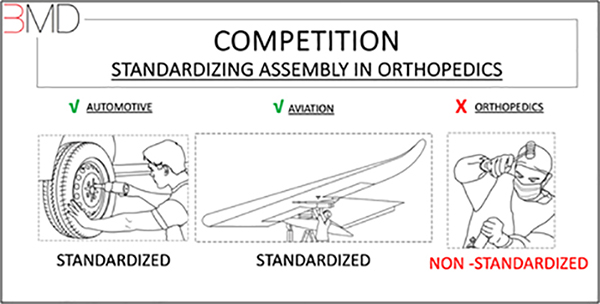
Orthopedic surgeons are a bit different from most other surgeons. Most surgeons typically dissect, cut, cauterize, and suture. Orthopedic surgeons do all of that, and in addition they apply large amounts of force to press fit implants to bone. During residency medical residents typically make fun of orthopedic residents by calling them “carpenters”, however, orthopedic surgeons are more appropriately likened to mechanics because most of the time they are assembling things with tools that deliver large amounts of force to the patient’s body. In that sense, orthopedic surgeons are like auto and aviation mechanics.

In these industries, there are strict standardization rules that are referred to as ISO, which applies to all aspects of the product including Materials, Design and Assembly.

Standardization ensures that every part, component, and assembly process adhere to strict guidelines and specifications. This helps maintain a high level of safety and reliability in the final product, reducing the likelihood of failure, defects and malfunction caused by inconsistencies and unproven practices.

This fact is never more relevant than today, as we see problems in aviation industry with assembly of airplane doors in the fuselage. We can all agree that we care equally as much about the material, design, and assembly of the plane in which we travel.

Assembly in Aviation

If we look at total hip replacement through this standardization lens, we can see that over the years (bio)materials and designs of implants have improved dramatically, however, the assembly process in orthopedics remains an enigma. Assembly in orthopedics remains a highly non-standardized and primitive process. There has been no improvement in this aspect of orthopedics.

In fact, four out of the five noted major problems in total hip replacement, namely aseptic loosening/periprosthetic fractures, mal-alignment, leg length discrepancy and metallosis can each be partly or wholly attributed to orthopedic surgeon’s non-standardized assembly technique.

In orthopedic surgery we basically press fit (interference fit) implants into bone and modular implants into each other. Press fit technology dates back centuries of Persian and Greek early civilizations, who used various forms of interference fit in their construction. For example, in woodworking, joinery techniques involved fitting parts together tightly without use of fasteners, screws or nails. However, in these arenas, carpenters work with material that generally have homogenous material properties, and if they make a mistake and break the wood, they simply replace it.

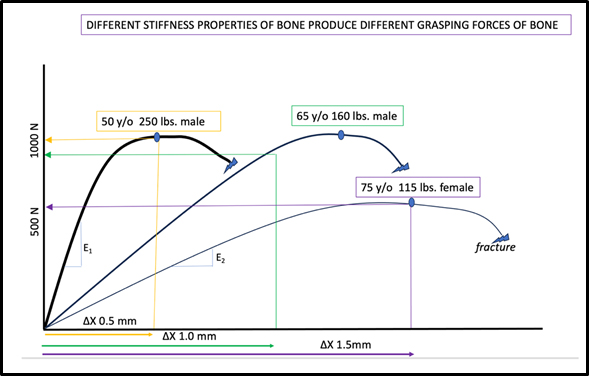
Conversely, in modern total hip replacement, we press fit metal implants, which are 10 to 20 times stiffer than bone, into a patient’s bone/body, that has vastly different strength and stiffness (modulus of elasticity) properties based on age and physiological condition.

We treat every patient the same regardless of age and bone quality. For example, regardless of age, we under- ream the acetabulum by 1mm and impact an acetabular cup that is one size larger.

But a 1mm under ream may be too little for a softer bone (you may need 2mm under ream to get a good press fit) and a 1mm under ream may be too much for a harder bone (you may only need 0.5mm under ream to get a good press fit).

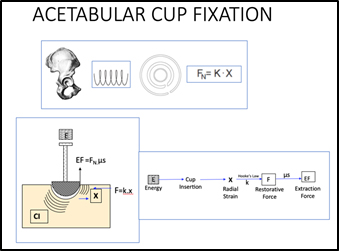
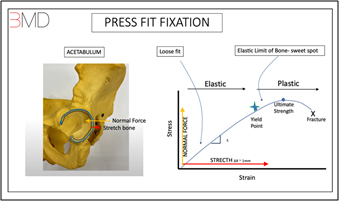
Basically, the grasping force of a bony cavity is FGrasp = FN. µs.

Where FN is the normal force at the implant/bone interface.

Wherein µs is the coefficient of static friction.

Based on Hooke’s law, FN is the product of modulus of elasticity of bone (K) and the radial strain or stretch of bone (∆X) at the implant bone interface.        FN = (K. ∆X).

To get FGrasp correct, you must get FN correct.  To get FN correct you must have an accurate sense of the values of K and X.

However, this is not part of our current practice. We treat all patients with the same technique regardless of age and quality of bone. It seems unwise to treat the acetabulum of an 80-year-old 140 lbs. female with the same technique used on a 50-year-old 250 lbs. male.  Because the modulus of elasticity- stiffness property (K) of bone is different in these two subpopulations, the Fgrasp will be different in these subpopulations.  Orthopedic surgeons need a tool that gives them some intra-operative measurement of K (the modulus of elasticity of bone).

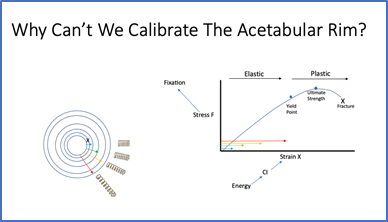
Additionally, it is imperative that surgeons get an accurate measurement of X (the true diameter of the cavity) because to produce the proper amount of ∆X (radial strain at the rim), the value of X must be known precisely. If for example, the diameter of the acetabular cavity is 54 mm and you believe it is 56 based on your templating, and then ream the cavity to 56 mm, you will forever destroy the elastic property of that acetabular cavity, since you will have disposed of the ring like, dense cortical rim, that produces all the grasping force of the acetabular bone.

Therefore, to get FGrasp correct, you need to have some reasonably close intraoperative estimate (measurement) of both K (the modulus of elasticity of bone), and X (the true size of the cavity).

Orthopedic surgeons need a tool that provides this metric for them. We have described this phenomenon as FORCE SIZING of bone, which we will discuss in detail below. This concept is explained in detail in the paper The Shoe Salesman, the Orthopedic Surgeon, and Force Sensing

BONE PREPARATION AND IMPLANT IMPACTION (TOO MUCH FORCE)

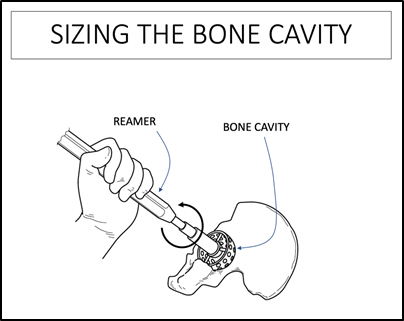
In general, when we press fit implants, we must prepare the bone with reamers and broaches. We qualitatively size the bone by feeling for “chatter”, a tactile sense of frictional resistance between the cutting instrument and bone. The first perennial question in every orthopedic surgeon’s mind is, “how much should I ream or broach?” If we ream or broach too little, we won’t get a good press fit, and conversely, if we ream or broach too much, we destroy the dense cortical bone that provides the grasping force.

If you guessed that this tool is unlikely to be in the form of augmented reality glasses (digitization), you are correct. (see conversation 2)

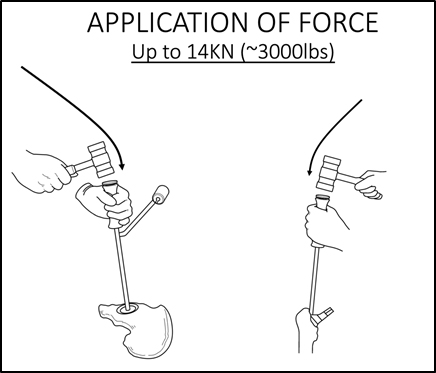
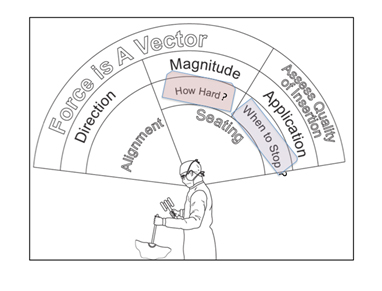
The second thing we do is to impact implants into bone. During this process, every orthopedic surgeon feels a little uncomfortable because when they apply force with a mallet to impact an implant into position, at least in their unconscious mind, they worry that they may be doing some damage to the patient. The second and third perennial questions in the orthoepic surgeon’s mind are following: “How hard should I hit? and When should I stop impacting?” There again we do not have any tools to help us deal with this issue.

We need tools that help us quantitatively determine the answer to these three questions:

  1. How much should I ream or broach?
  2. How hard should I hit?
  3. When should I stop impacting?

This is significant because use of power tools and mallets is what distinguishes orthopedic surgeons from other surgical specialties. The orthopedic medical device companies have not provided us with solutions to these questions and have treated orthopedic surgeons as if we are general surgeons, urologists, or ophthalmologists.

It is as if the medical device companies have told the orthopedic surgeons that technology does not apply to bone preparation with power tools, nor to application of force with a mallet. Technology only applies to digitization, virtual reality, and spatial positioning of implants, as if the field of orthopedics itself is a videogame.

Additionally, medical device companies, at times, seem to be unaware of who their clients are. One million total hip replacements are performed globally and 80% of these cases are being done by surgeons who do less than 10 total hip replacements per year. Most orthopedic surgeons who are doing these cases are already stressed out because the procedure is not routine to them.

The idea of placing a bulky robot in the operating room, adding 30 minutes to establish a global positioning system by 1. Applying trackers/sensors to bone with screws and clamps 2.  Performing landmarking, calibration and registration processes 3. Becoming dependent on additional personnel who recently graduated college 4. And finally dealing with glitches and line of sight issues is enough to drive the orthopedic surgeon crazy.

In addition to the cost issues related with robotics, these are the reasons why the adoption of robotic total hip replacement is at 1%, despite the extensive marketing. I believe the vice president is wrong.

Perhaps incorporating robotics in the orthopedic operating room was a technology that seemed reasonable at the time, but there are peculiarities in this field that would prevent it from ever gaining acceptance.

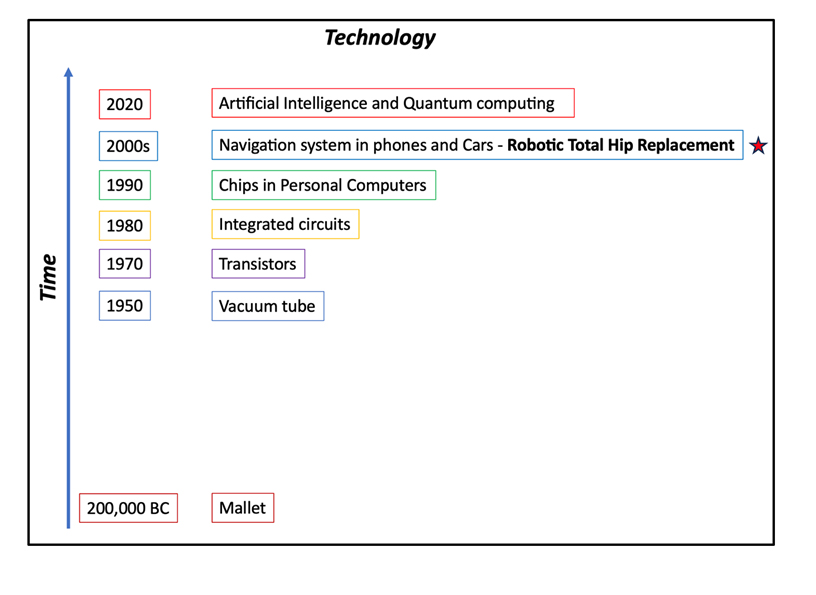
The premise of many of the robotic systems, which were developed in the 1990’s, was that a global 3-D coordinate system in the OR space is required to get better visibility of the implants alignment.  Navigation came into our operating rooms at the same time it showed up in our parent’s BMWs and Benzes.

However, we believe with the advent of second and third generation sensors, this original navigation technology, which tends to overload the surgeon’s brain, is passe and counterproductive.

In addition to the issues described above, there is the glaring deficiency of the robotic platforms, which is that they do not help orthopedic surgeons with management of force.  These robotic platforms are devoid of technological advancements, particularly sensing technologies, in use of power tools (reamers, broaches, mallet).

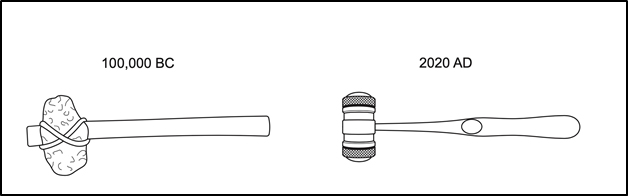
Ultimately the mallet has not changed form over the last 100,000 years and we are still using it.

Furthermore, development of automatic percussive impacting tools does very little to improve this situation.

This summons the admonition from Donald Cuduto’s book Foundation of Design, which states that we should maintain the same degree of precision in analysis, design, and construction. In common vernacular, this translates into don’t measure with a micrometer, mark with a chalk, and cut with an ax. But this is precisely what we are doing with the robots and the mallet.

This brings us to the first problem in the modern total hip replacement, which is we do not have the tools to properly size bone.  We need a tool that answers the question: how much do I ream or broach?

If we undersize the cavity, that is if we think the cavity is smaller than it actually is, we place an implant that does not get good press fit (the cavity is too big for a good press fit), the implant gets loose. Conversely, if we oversize the cavity, that is if we think the cavity is larger than it actually is, we impact too big of an implant and cause a fracture (the cavity is too small for a press fit); or alternatively we ream away the dense cortical bone at the rim of the cavity that produces all the grasp.

To get a good press fit, the first obligatory requirement is to get an accurate measure of not only the size of the cavity X but also the stiffness properties of the cavity K.

We can therefore demand the following from our medical device executives. We need a tool that gives orthopedic surgeons the ability to quantitatively and intra operatively measure (or at least help us infer) the values of K (modulus of elasticity of bone) and X (true size of the cavity).

Right now, all we have is preoperative templating, where we measure the diameter (a distance measurement) of the bony cavity on an X-ray or CT scan. The literature is replete with papers that show how experienced surgeons frequently disagree with their own templating at the time of the operation. For instance, a surgeon’s templating tells her that the acetabulum is a size 54, but her tactile and auditory senses tell her she is not feeling enough chatter and therefore the acetabulum must be bigger than 54. Should she ream to 56mm? what if she is wrong? Then she will destroy the dense cortical rim that provides the grasping force. We can see how this creates a moral crisis and anxiety for the surgeon during the operation. This is particularly important because many investigators have shown that being off by one size can lead to either fracture or loosening, both of which can be catastrophic.  Recent awareness of this issue has prompted the American Academy of Orthopedic Surgeons (AAOS) and similar European agencies to recommend use of bone cement instead of press fit (for femoral components) in patients 65 years of age and older.

Influence of Stem Size and Position on Periprosthetic Fracture Risk and Primary Stability in THA, ISTS

As a solution we proposed the concept of FORCE SIZING, which is originally discussed in the paper (HOW CAN WE MAKE PRESS FIT ARTHROPLASTY MORE RELIABLE? The Shoe Salesman, the Orthopedic Surgeon, and Force Sensing).

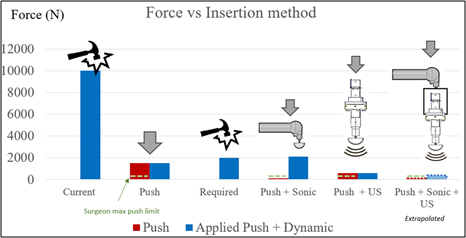
To make matters worse, while we are neither aware of the proper size of the bony cavity (X), nor the modulus of elasticity of the cavity (K); we ask orthopedic surgeons to use a 4 lb mallet to impact the prosthesis into bone. Surgeons use up to 10KN to 14KN of force to impact prosthesis into bone.

Consider the following example. If you have sized the bony cavity properly, you may have a chance at getting good press fit. Based on our bench top studies with 20 pcf. foam, it takes

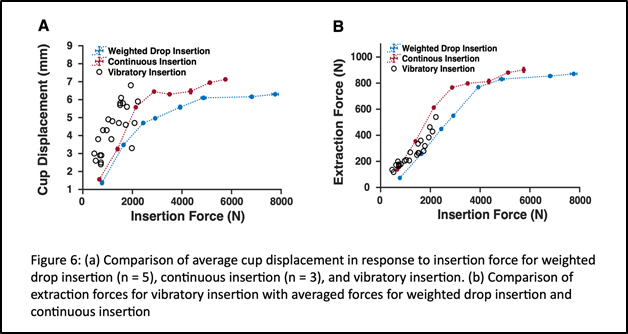
~ 4KN to insert the cup into bone, and ~ 1KN to extract the cup out of the bone.

Characterization of Acetabular Cup Insertion Forces in Cancellous Bone Proxy for Validation of an Invasive Sensing Model and Development of Automatic Prosthesis Installation Device: A Preliminary Study

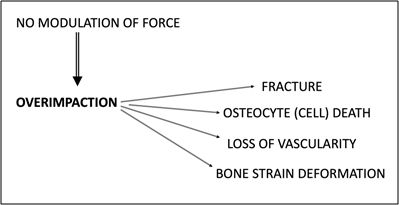
That is your extraction to insertion force ratio is 25%. In other words, you used 4 times as much force to put the cup in as it took to take it out. However, many times, surgeons may use upwards of 10KN of force to impact a prosthesis into bone. You must consider exactly where that force goes. After the work of insertion, much of this extraneous force goes into doing damage to bone cells, bone vascularity, in addition to causing fractures and damaging bone (possibly the hidden cause of aseptic loosening). Please see paper by Professor J.R.T. Jeffers on Bone Strain Deformation.

Impaction technique influences implant stability in low-density bone model

THEORY-LESS VS THEORY-FULL

Therefore, you can see that in modern total hip replacement the process of bone preparation/sizing and implant installation is highly primitive. This brings up the question as to how parts of a successful field of medicine, orthopedics, can be so crude and unrefined.

Dr Leslie Valiant, Mathematics and Computer Science professor at Harvard University describes his Probably Approximately Correct theory.   Which essentially states that during most of our daily lives we do things that work but have not figured out exactly how they work. We just know that they work.  We have mostly figured things out in nature through trial and error. Our brains are not designed to be like rigorous mathematicians, using deductive reasoning for every conclusion we make. That is too exhaustive.  Our brains are designed to cope with the environment and make estimations of what works in real life, using minimal cognitive effort. We are constantly doing that in conducting our daily lives, such as choosing a mate, dealing with difficult social situations, dealing with our finances.  He calls this concept theory-less.  That seems to be good enough for most of our interactions with nature.  When we have completely understood some concept and abstracted a formula behind the concept, then he calls it theory-full. Classical mechanics, E=mc2, relativity, etc.  Most of what we do in daily life is theory-less.  Mathematics is the most rigorous field of science, where every conclusion requires a proof by deductive reasoning, where you have to combine accepted facts that compels acceptance of a conclusion. Mathematics is theory-full.  In contrast, in medicine, many times we do things because we know it works, but don’t know exactly why it works. Some of our reasoning and conclusions are just drawn from inductive reasoning. We simply believe something is true because we observe repeated instances of the same phenomena.  Current press fit technology in total hip replacement is a perfect example of Theory-less.  We know press fitting metal into bone works but we have not figured out the exact formula for it.  We must make press fit arthroplasty in orthopedics theory-full.  That is, we must understand exactly how press fit works when stiff metal implants interact with the variety of softer bones.  We must do this to make procedures safer for patients and to decrease cost to society.

We can do this by 1. Developing tools that allow surgeons to quantitatively and intra-operatively determine the elastic limit of bone (Force Sizing). 2. Providing tools that minimize insertion force during implant installation, preventing unwanted damage to host bone (Vibratory Insertion).

ELECTRONIC SIGNATURE SIZING OF BONE CAVITIES

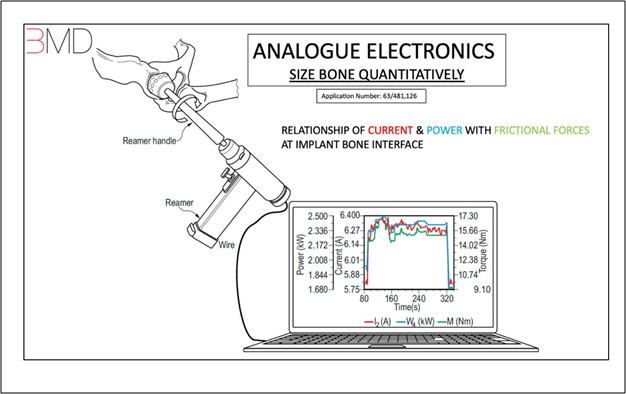
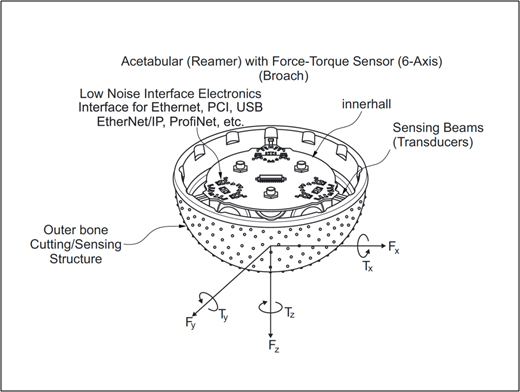
The idea of Force Sizing describes how analogue electronics can be used to determine the contact conditions at the implant/bone interface. In other words, since transient electric power and current consumption of driving motors used in reamers and broaches, have a direct linear relationship with the frictional forces at the implant/bone interface, these relationships can be utilized to provide a quantitative and intra-operative assessment of the implant/bone contact conditions. The surgeon can now infer the elastic limit of bone, and the values of X and K.

This concept is fully explained in the paper (ELECTRICAL SIGNATURES AND FORCE/TORQUE SENSORS AS METHODS FOR SIZING BONE FOR PRESS FIT ARTHROPLASTY)

VIBRATORY INSERTION OF ORTHOPEDIC IMPLANTS

Once we learn to force size bone cavities properly, we can then think of ways to apply less force to install implants. This will be important in minimizing damage to bone cells, structure, and vascularity.

Have we asked ourselves why we must use so much force to insert implants into bone?  Is it possible to use less force to install implants? Why is it typical in modern total hip replacement to have the insertion force be four times (sometimes 10 times) as high as the extraction force?

Is it possible for insertion and extraction force to be the same?

Is it possible for the insertion force to be one half or one tenth of the extraction force?

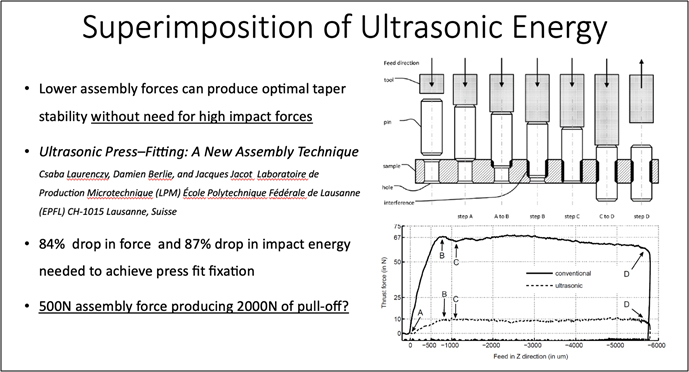
These goals seem fantastical until we realize that these situations have already been discovered in other industries. Superimposition of sonic and ultrasonic vibration on static force has been shown to dramatically reduce the energy/force required for force press fit fixation.

Why can we not emulate this concept in total hip arthroplasty press fit?

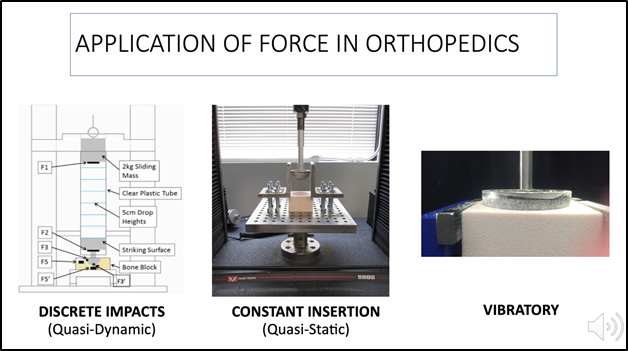
We studied alternate methods of insertion technique including discrete impacts, constant insertion, and vibratory insertion. We found vibratory insertion to be the most efficient.

Vibratory insertion has a different magical quality to it because it summons a bit of the micro-world of “Quantum Mechanics”, as opposed to the macro-world of “Newtonian” discrete impacts.

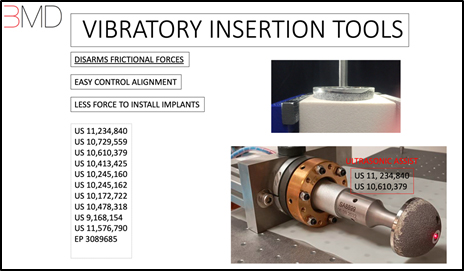
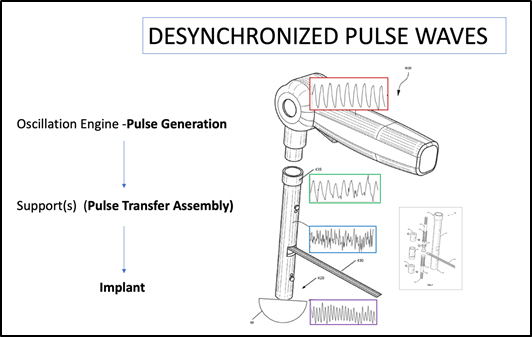
Vibratory insertion tools use an oscillation engine to create desynchronized pulse waves, which travel down a series of supports and eventually vibrate the implant. This phenomenon allows the implant to be pushed into place rather than impacted into place.

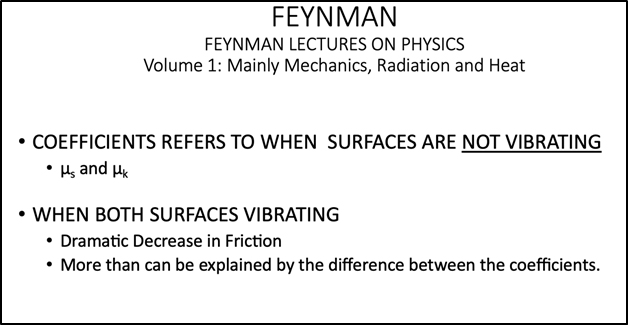
Vibration dramatically reduces the frictional forces between two surfaces. This is much more than the difference between coefficients of static and kinetic friction. We know that the coefficient of kinetic friction is lower than the coefficient of static friction by 30% to 50%. However, this is the case when two objects are moving against each other. Professor Feynman explains that when vibration is present, all bets are off, and the decrease in friction is significantly more than can be explained by the difference between the coefficients of static and kinetic friction.

Another valuable quality of vibration is that because the frictional forces are disarmed the surgeon can now freely and without resistance alter the alignment of the implant, while the implant is vibrating. The simple addition of IMU technology to the vibratory insertion tool now allows surgeons to place the acetabular component in the exact desired alignment.

This satisfies another one of the orthopedic surgeon’s unmet needs, which is to have the ability to effortlessly control and monitor the direction of force, and therefore the alignment of the implant.  

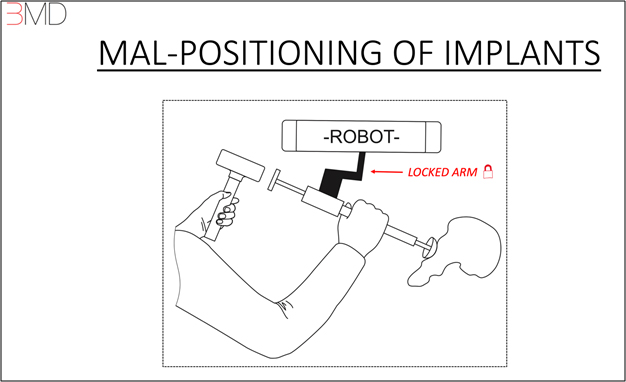
This is in contradistinction to the robotic platforms. Robotic systems constrain the alignment of the implant during the impaction process. Since installation is still done with a mallet, the implant is locked into place with every blow of the mallet. Therefore, robots do not allow any adjustment of the implant. They only constrain where you can put the implant, and you can only see alignment after the fact.

To recap, up to this point the Analogue Electronics will help force size bone cavities properly and Vibratory Insertion will allow us to install implants with minimal force. This with the added benefit of being able to simultaneously insert, align, and monitor the implant’s position.

Adoption of these innovations allow us to potentially eliminate 50% of total hip replacement failures, which have to do with 1. Aseptic loosening/ periprosthetic fractures, and 2. Mal- alignment of implants.

The problems that remain include:

  1. Leg length and offset.
  2. Infection
  3. Metallosis

LEG LENGTH AND OFFSET: TOO MUCH INFORMATION

Let’s talk about leg length and offset. Managing leg length and offset is critical to success of any total hip replacement. Both for stability of the implant and to prevent leg length discrepancies, which is the most common cause of lawsuits in orthopedics.

In the late 1990s, the medical device community provided us with navigation and robotics to assist surgeons with visibility of the implant’s position (leg length, offset and alignment).  However, as we discussed earlier, robotic platforms seem to have come at a great price. These platforms involve establishing a global positioning system in the OR space, which in turn involves too much bulk, extra workflow, too many glitches, too much human mechanical involvement including (screws, clamps, landmarking, registration, calibration), and line of sight issues.  All of which add to compounding of errors, cost, time efficiency and most importantly cognitive load.
Humans are clearly limited in their information processing capacity in comparison with computers. The human brain can process two words per second, whereas the typical computer in our phones can process 10 million words per second. For humans there is an inflection point at which additional data processing leads to decreased performance.  It may be that the vice president in conversation 1 believes that the orthopedic surgeons are like the fictitious Martian figure, with a big brain, and the capacity to process tons of information. (see conversation 1)

It is not that orthopedic surgeons do not appreciate the benefits of robotic platforms (accuracy and better visibility of implants), it is that we feel that engagement with these platforms make us less effective. What we really want is all the same information without being overwhelmed.

We want to see leg length and offset in real time, instantaneously and without all the trouble of having to establish a global coordinate system in the OR space, added workflow, extra personnel, and the additional cognitive load.

CENTRAL COGNITION VS. EXTENDED COGNITION

As a solution, we considered localizing and distributing the use of sensors in orthopedics as opposed to centralizing them in the robot. Local positioning systems can be developed with self-contained microelectronics that have none of the disadvantages of the global positioning system of the robot.  Local positioning systems can be developed with radiofrequency and electromagnetic systems with the SCREW SENSOR concept, showing real-time instantaneous changes in leg length and offset.

AN ALTERNATIVE TO ROBOTICS IN TOTAL HIP ARTHROPLASTY – LSI EUROPE 2023

The difference between what the surgeons are given in current robotic platforms and what they may get in the screw-sensor concept is best characterized in the distinction between central cognition vs extended cognition.

Animal (human) cognition is defined as the acquisition, processing, storage, and use of information.

Does cognition occur in the central nervous system CNS (brain) of the animal in or in a functionally dedicated neural system that may surround the animal? Biologists call cognition that is confined to the CNS central cognition and cognition that is distributed to the surrounding environment extended cognition. Central cognition requires much more computational power because it has to construct models of the external world. Extended cognition, on the other hand is less demanding in terms of information management, and therefore information is offloaded to the body or the surrounding environment.

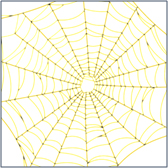
The best way to understand extended cognition is to study the behavior of spiders. When spiders build their webs, they wait to feel the vibrations in the web’s threads that are caused by struggling prey. When they sense movement of the threads, they move towards the direction of the signal. Spiders have a way of remembering the locations where the best foods were caught. In designing the future webs, spiders rather than remembering the locations that have done well, that is rather than storing these locations in their minds, the spiders weave this information into their web. In particular, they use their legs to tug on specific silk threads from which the prey has recently been detected, making them tighter. The tighter threads are more sensitive to vibrations, making future pray easier to detect on them. These alterations in the web offload some of the burden of cognition to its environment. Spiders expel their current knowledge and memory into a compact yet meaningful physical form.  This interacting system of the spider and its web is smarter than the spider can hope to be on its own. This outsourcing of intellect to the environment is extended cognition. (Models of the Mind, Grace Lindsey).
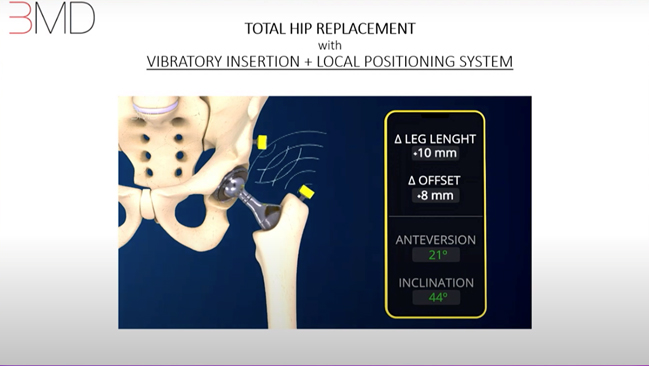
The Screw-sensor concept allows orthopedic surgeons to have effortless and instantaneous access to the patient’s leg length and offset information, during the surgery, without excessive cognitive burden. Therefore, in a similar way to the spider’s web, the screw-sensor concept offloads the burden of cognition (relating to calculating leg length and offset) to the surrounding distributed electromagnetic network of the screw-sensors.

We can now see why orthopedic surgeons may want to be like Spiders rather than Martians.

To recap, at this point, with the concepts of ANALOGUE ELECTRONICS, VIBRATORY INSERTION and SCREW-SENSORS, we now have the computational and technological capacity to STANDARDIZE THE ASSEMBLY TECHNIQUE IN ORTHOPEDICS.

Analogue Electronics will help us force size bone cavities properly.

Vibratory Insertion will allow us to install implants with minimal force. This with the added benefit of being able to simultaneously insert, align, and monitor the implant’s position.

Screw-Sensor concept will allow us to eliminate leg length and offset problems.

STANDARDIZATION OF ASSEMBLY TECHNIQUE IN ORTHOPEDIC SURGERY – LSI 2023 USA

These innovations will address, and potentially solve 80% of all total hip replacement failures including: aseptic loosening/ periprosthetic fractures, mal alignment of implants, and leg length and offset problems.

The last two problems of Metallosis and Prosthetic Infections are not particularly associated with surgeon assembly technique but rather with design issues. I would like to share two patents that describe changes in design that address these two problems.

METALLOSIS AND TRUNNIONOSIS and the TRIANGLE

For the problem of Metallosis and Trunnionosis relating to modular implants we have previously provided a paper, which is again referenced here.

Surgeon Controlled Factors Eliminating Taper Corrosion and Trunnionosis

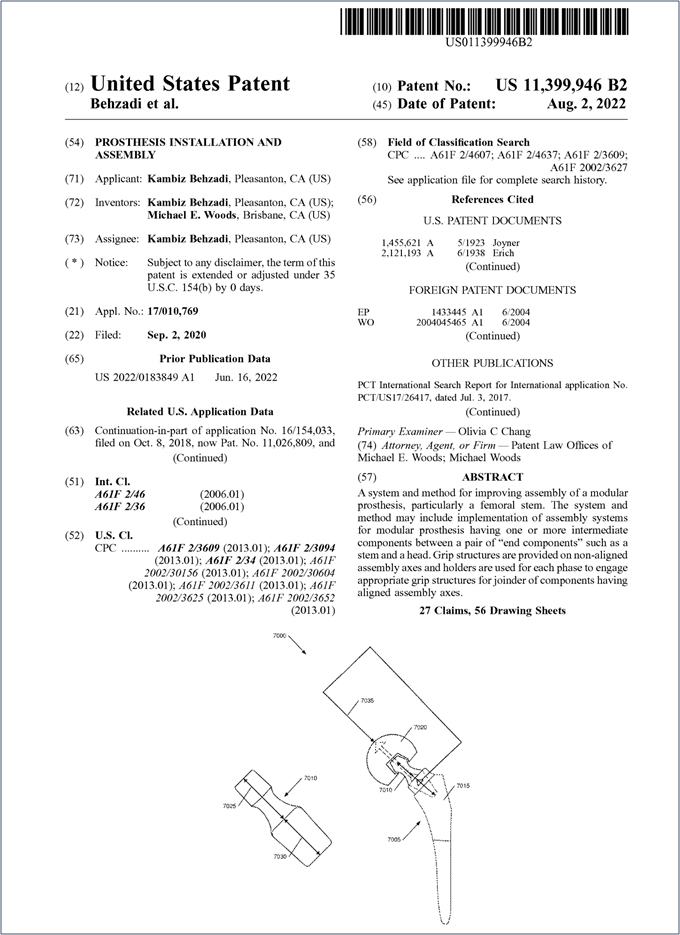
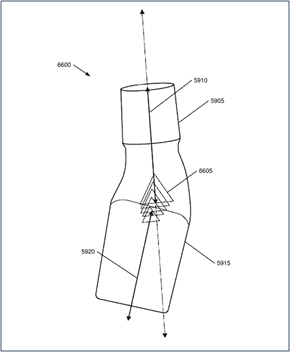
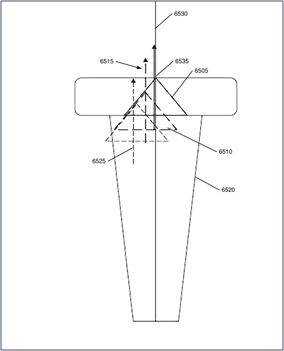
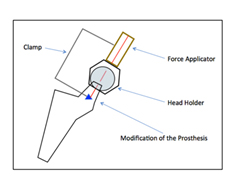
I would like to share one of the most recent patents relating to this work that highlights the significance of design and in particular the “triangle” which is the singular configuration that assures that force applied across the head and trunnion and/or trunnion and stem is perfectly co-linear and orthogonal, allowing for a cold weld. Any other geometric configuration is still predisposed to canting. See patent and figures.

Double taper Cold welding of all modular prosthesis.     US 11,399,946

PRE-INFECTION DETECTION: BIOSENSORS ON IMPLANTS Pre-COGS

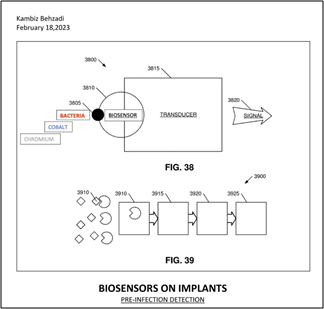
For the problem of infection in total hip replacement, I would like to share this paper and associated patent again, which reviews the concept of pre-infection detection.  The incorporation of biosensors on implants provides extreme early detection of bacteria around the implant, long before a bacterial invasion occurs and long before a clinical infection is declared.

We named this concept pre-infection detection, borrowed from the Pre-cogs of the movie Minority Report. Current methods are designed to catch an orthoepic infections after the bacterial invasion, and after the clinical infection has occurred. Pre-infection Detection is a system that detects infection in orthopedics before it ever occurs.

BIOSENSORS ON IMPLANTS PRE-INFECTION DETECTION

Conclusion

 In conclusion, we have proposed five concepts including Force Sizing, Vibratory Insertion, Screw-Sensor, Triangle and Pre-Infection Detection. We believe development and adoption of these technologies will have a major impact in resolving the five major complications in the Modern Total Hip Replacement.