Electronic Signature Sizing of Bone (ESSOB): A Paradigm Shift in Press Fit Arthroplasty

Electronic Signature Sizing of Bone (ESSOB): A Paradigm Shift in Press Fit Arthroplasty

Executive Summary

The Electronic Signature Sizing of Bone (ESSOB) technology represents a transformative advancement in orthopedic surgery, addressing a critical gap in total hip replacement (THR) procedures. Currently, 50% of THR failures stem from improper bone sizing during press fit implant preparation—a procedure that relies entirely on surgeons’ subjective auditory, tactile, and visual assessment. With 800,000 of the 1 million annual THR surgeries worldwide performed by surgeons conducting fewer than 10 procedures per year, ESSOB offers a quantitative, standardized solution that can democratize surgical excellence and dramatically improve patient outcomes.

The Clinical Challenge: A $10 Billion Problem

Current State of Press Fit Arthroplasty

Press fit arthroplasty remains fundamentally unchanged since its inception—surgeons prepare a bone cavity approximately 1mm smaller than the implant diameter and impact it into position. The success depends entirely on achieving optimal primary stability through interference fit, maintaining less than 50μm of micromotion at the implant-bone interface.

The Goldilocks Dilemma

Bone behaves as a stiff circular composite spring with distinct elastic properties:

  • Under-reaming (cavity too large): Results in implant loosening, subsidence, and failure
  • Over-reaming (cavity too small): Causes fractures, osteocyte death, vascular damage, and loss of elasticity
  • Optimal sizing (0.5-1.0mm press fit): Achieves maximum stability without exceeding bone’s elastic limit

Currently, surgeons navigate this critical balance using only qualitative sensory feedback—listening for pitch changes, feeling resistance, and observing bleeding bone. This subjective approach yields inconsistent results, particularly for less experienced surgeons who perform the vast majority of procedures globally.

ESSOB Technology: Quantifying the Unmeasurable

Core Innovation

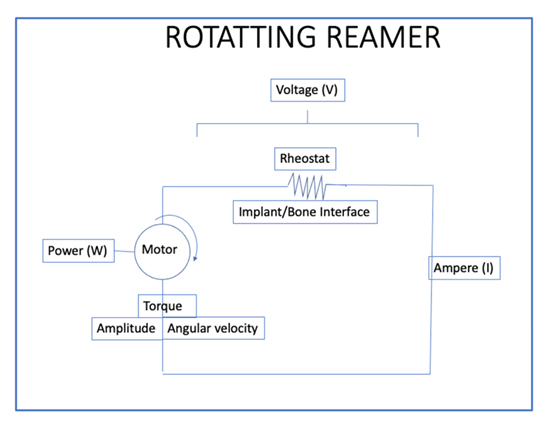
ESSOB transforms bone preparation from art to science by monitoring real-time electrical signatures of driving motors during reaming and broaching. The technology operates on a fundamental principle: the implant-bone interface acts as a variable rheostat, causing measurable changes in current and power consumption that directly correlate with bone elasticity and contact conditions.

Dual-Mode Sensing Architecture

Power Absorption Mode

  • Measures transient electric power and current consumption of driving motors
  • Detects inflection points indicating elastic limit achievement
  • Monitors parameters including current, voltage, active power, torque, and angular velocity
  • Utilizes ultrasonic harmonics (2nd and 3rd order) when applicable

Power Transmission Mode

  • Employs force/torque sensors with strain gauge arrays
  • Provides six-degree-of-freedom force measurements
  • Directly quantifies bone-implement interface forces
  • Enables real-time cavity size estimation

Advanced Signal Processing

The system incorporates Kalman Filter algorithms (including Extended and Unscented variants) to:

  • Optimize frictional force and torque measurements
  • Enhance signal-to-noise ratios in real-time
  • Compensate for surgical environment variables
  • Predict bone elastic limit with high accuracy

Clinical Implementation Strategy

Immediate Applications

Intraoperative Guidance System

  • Real-time digital display of bone contact conditions
  • Visual/auditory alerts approaching elastic limit
  • Quantitative sizing recommendations
  • Integration with existing surgical power tools

Standardization Protocol

  • Establish procedure-specific sizing algorithms
  • Create bone quality assessment metrics
  • Develop surgeon-independent preparation protocols
  • Enable consistent outcomes across experience levels

Extended Capabilities

Multi-Joint Applications

  • Acetabular and femoral preparation (hip)
  • Glenoid preparation (shoulder)
  • Tibial/femoral preparation (knee)
  • Adaptable to all press fit procedures

Modular Assembly Optimization

  • Precise force measurement for head-trunnion assembly
  • Prevention of metalosis and trunnionosis
  • Elimination of cold weld variability
  • Standardized assembly protocols

Transformative Impact and Market Opportunity

Clinical Benefits

  • 50% reduction in revision surgeries: Through optimal primary stability
  • Fracture prevention: Real-time elastic limit detection
  • Democratized excellence: Novice surgeons achieve expert-level outcomes
  • Reduced complications: Prevention of osteocyte death and vascular damage

Economic Value Proposition

  • $10+ billion annual savings: Reduced revision procedures and complications
  • Decreased liability: Objective, documented sizing decisions
  • Shorter learning curves: Quantitative feedback accelerates skill development
  • Global scalability: Particularly valuable in underserved markets

Competitive Advantages

  • First-to-market: No existing quantitative sizing solutions
  • Platform technology: Applicable across all press fit procedures
  • Data ecosystem: Creates valuable surgical outcome database
  • AI integration ready: Machine learning optimization potential

Development Roadmap

Phase 1: Clinical Validation (Months 1-12)

  • Complete prototype integration with commercial power tools
  • Conduct cadaveric studies validating elastic limit detection
  • Initiate multi-center clinical trials (n=500 patients)
  • Develop surgeon training protocols

Phase 2: Regulatory Approval (Months 12-24)

  • Submit 510(k) application with predicate device strategy
  • Complete ISO 13485 certification
  • Establish quality management systems
  • Initiate CE marking process for European market

Phase 3: Market Launch (Months 24-36)

  • Partner with leading implant manufacturers
  • Implement at high-volume orthopedic centers
  • Develop cloud-based analytics platform
  • Create outcome tracking database

Phase 4: Platform Expansion (Months 36+)

  • Extend to robotic surgery integration
  • Develop AI-powered predictive algorithms
  • Expand to trauma and revision procedures
  • Create personalized surgical planning tools

Strategic Recommendations

Technical Development Priorities

  1. Miniaturization: Integrate sensors directly into surgical instruments
  2. Wireless connectivity: Enable real-time data transmission and analysis
  3. Machine learning: Develop predictive models from accumulated data
  4. Augmented reality: Provide visual overlay guidance during surgery

Commercial Strategy

  1. OEM partnerships: Integrate with major power tool manufacturers
  2. Value-based pricing: Align cost with documented outcome improvements
  3. Training academies: Establish ESSOB certification programs
  4. Data monetization: License anonymized outcome data for research

Regulatory Approach

  1. De novo vs. 510(k): Evaluate optimal FDA pathway
  2. Clinical evidence: Design studies demonstrating superiority
  3. Reimbursement strategy: Engage payers early with economic data
  4. International harmonization: Pursue simultaneous global approvals

Conclusion: The Future of Orthopedic Surgery

ESSOB represents more than incremental improvement—it fundamentally transforms how surgeons approach press fit arthroplasty. By providing objective, quantitative measurements of bone elasticity and contact conditions, ESSOB eliminates the guesswork that currently plagues orthopedic surgery.

The technology’s immediate impact will be measured in prevented fractures, reduced revisions, and billions in healthcare savings. However, its ultimate legacy lies in democratizing surgical excellence—ensuring that every patient, regardless of their surgeon’s experience level, receives optimal care.

As orthopedics advances toward personalized, data-driven medicine, ESSOB provides the foundational technology for this transformation. The question is not whether quantitative bone sizing will become standard of care, but how quickly the orthopedic community will embrace this paradigm shift.

The convergence of clinical need, technological readiness, and economic imperative creates an unprecedented opportunity. ESSOB is positioned to become the gold standard for press fit arthroplasty, establishing a new era of precision, consistency, and excellence in orthopedic surgery.

For more information on ESSOB technology and partnership opportunities, contact Autonomous Orthopedics.