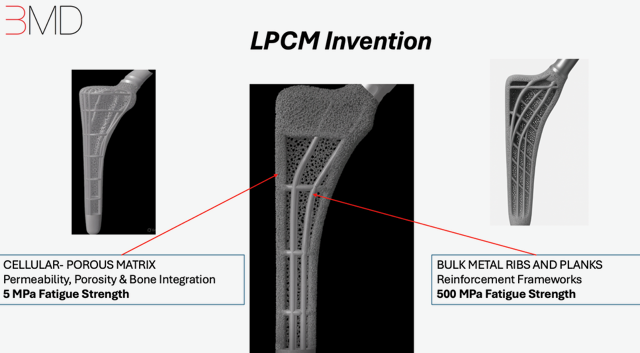
Orthopedic implant design is trapped between two unsatisfying extremes. Traditional bulk-metal designs in Ti-6Al-4V and CoCr-Mo offer excellent strength and fatigue life, but are 6–10× stiffer than bone. This stiffness mismatch produces non-physiologic load transfer, stress shielding, and progressive bone resorption, ultimately undermining long-term fixation. At the other extreme, porous and cellular metallic architectures—enabled by additive manufacturing—better match bone modulus and support osseointegration, but suffer from junctional fatigue, manufacturing defects, and micromotion levels that push healing toward fibrous encapsulation rather than bone integration.
For decades, the industry has tried to compensate with increasingly sophisticated geometry: collars, flares, wedges, tapers, and “fit-and-fill” stems. These geometry-based load paths improve primary stability but provide only a handful of crude load-path “hacks” that do not reproduce the distributed, hierarchical load sharing of native bone—especially under high loads such as running (5–7× body weight).
This white paper introduces Load Path Cellular Metal (LPCM): a structural architecture that embeds bulk-metal ribs, planks, and tubes within a functionally graded cellular matrix. LPCM achieves the holy trinity of orthopedic design—strength, flexibility, and porosity—with each parameter independently tunable. Instead of relying on geometry alone, LPCM uses engineered load paths to create biological load sharing, aligning implant mechanics with bone biology and opening a path to implants that can safely support higher functional demands while preserving bone stock.